Regulations
Visual Appearance: Perception, Measurement and Metrics
Visual appearance is one of the most critical parameters affecting customer choice and needs in products. We use the response from our visual sense to process the complex patterns of light around us into objects, space, location and movement, and from that information, we make judgments leading to…
A starting point in assessing the appearance of a consumer product might be the measurement of its color, however, it cannot be achieved by the definition of color alone; other attributes of the material from which it is fabricated contribute to the overall appearance. Additional parameters include surface texture, translucency, gloss, fluorescence, polarization and temporal properties. The appearance of an object is related to the physical structure of the material, the illumination condition, the visual environment, but also relates to the observer: A "trained" observer may perceive differences between similar objects that are not directly perceived by a non-expert.
The relationship between the physical structure of a material and its optical radiation properties (scattering, reflection, etc.) is complex. For example, selective absorption, which is largely responsible for the color of a material, takes place during the passage of light through that material.
In addition, there are a number of modern materials where color measurements made by using a single pair of influx/efflux geometries is not sufficient to describe the perceived colorimetric effect. Examples are effect paintings (i.e. car coating) showing goniochromatic effects (change of color with angle - shown in Figure 1) and sparkle (small bright spots in darker environment).
Fields of applications are very broad and include cosmetics, textile, packaging, and consumer electronics, such as laptops or smartphones. A new activity is virtual prototyping: Based on the measurement of optical properties of surfaces at micrometer scale, virtual objects are created and put into virtual reality. This approach allows realistic simulation prior to when the object is physically built.
CIE considers the field of appearance as one of the ten top priorities as outlined in its research strategy [2].
Some key questions defined in the strategy are:
• What are the relevant parameters to describe appearance, gloss and
translucency of various materials, including goniochromatic and
sparkling samples?
• Which BRDF geometry (size, polarization, shape and uniformity of the
illuminated area) according to the type of sample under investigation
shall be standardized?
• If a simplified geometry is used as a standardized description of effect
materials, how can the "uncertainty" with respect to the real visual
appearance, i.e. the proficiency of the test method, be described?
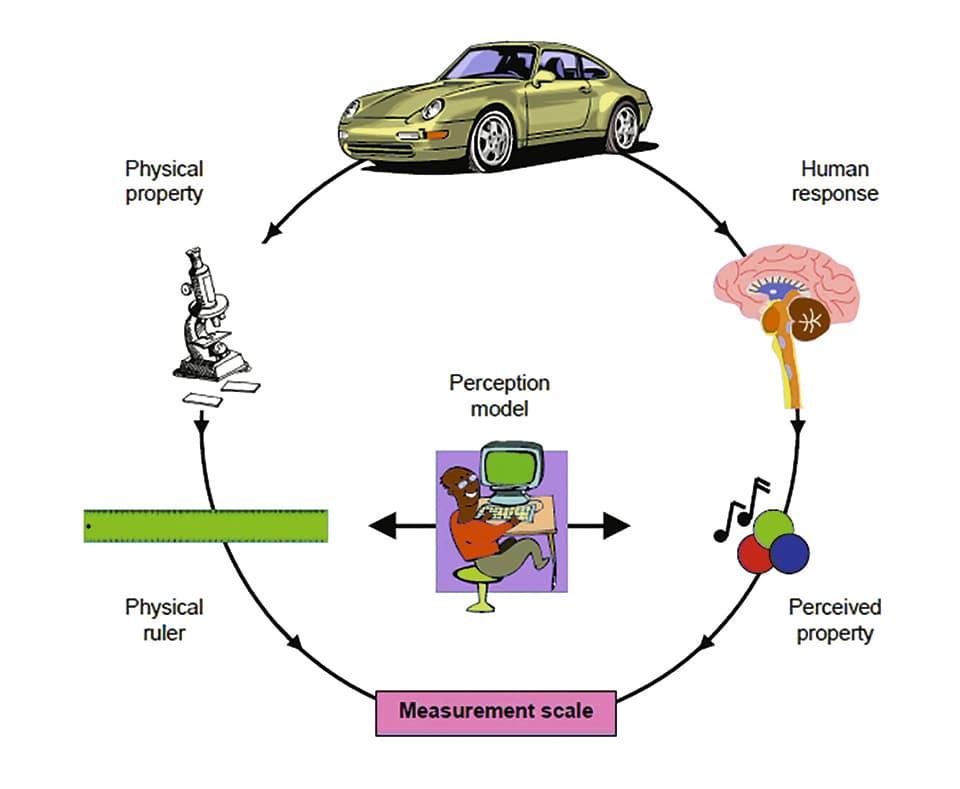
The scientific community is invited to investigate the measurement of appearance and to correlate theses measurements to the visual appearance. A starting point is the CIE technical report 175:2006 [1] which outlines a framework of visual appearance (Figure 2). It proposes four headings under which possible measures might be made: color, gloss, translucency and texture. These groups are perhaps not definitive but they are intuitive and represent useful categories for measurement, especially in view of the fact that measurement techniques already exist for some of them. In addition, note that they are not independent in that there must be links between color and gloss, and color and translucency, etc. (Figure 3).

Figure 2: A perception model that relates a physical property of an object as measured, to an aspect of that object defined by a human response [1]

Figure 3: CIE 175 proposal of sub-division of the optical properties of materials into measurement groups - with interactions between those groups
In addition, CIE has started several technical committees working on some of the aspects appearance [3]:
• The cross divisional JTC 12 "The measurement of sparkle and
graininess" will define measurand and requirements for their
measurements. The goal is that different instruments can provide the
consistent spectrophotometric data from the same specimen. In addition,
psychophysical methods will be recommended to obtain visual data to
develop the measurement scale for sparkle and graininess.
• TC2-85 prepares recommendations on the geometrical parameters
for the measurement of the Bidirectional Reflectance Distribution
Function (BRDF)
• A new JTC " Gloss measurement and gloss perception - A framework for
the definition and standardization of visual cues to gloss." is presently in
approval stage. It will describe recommendations for standardized visual
assessment conditions of individual, established cues to surface gloss
and suggest optical methods and metrics for describing surface gloss in
correlation with the established gloss cues.
The field of visual appearance is complex and highly cross topical. Only a joint international effort that includes all stakeholders (i.e. instrument manufacturers, testing laboratories, national metrology institutes, universities, product manufacturers and user communities) will bring us closer to the goal of better understanding of measuring and quantifying appearance.
References:
[1] CIE 175:2006 A Framework for the Measurement of Visual Appearance
[2] CIE research strategy: http://www.cie. co.at/research-strategy
[3] CIE technical committees: http://www.cie.co.at/technical-work/jtcs