mean well

Optics

Method to Calculate Melanopic Light Reaching the Retina Depending on the Optical Density of an Aging Crystalline Lens

Lighting studies that take into account the age of the inhabitants of an area and are related to circadian light are difficult to find. This study aims to simplify a method to approximately compute the circadian light reaching the retina based on photopic illuminance reaching the corneal plane and…

Published by LED professional ·
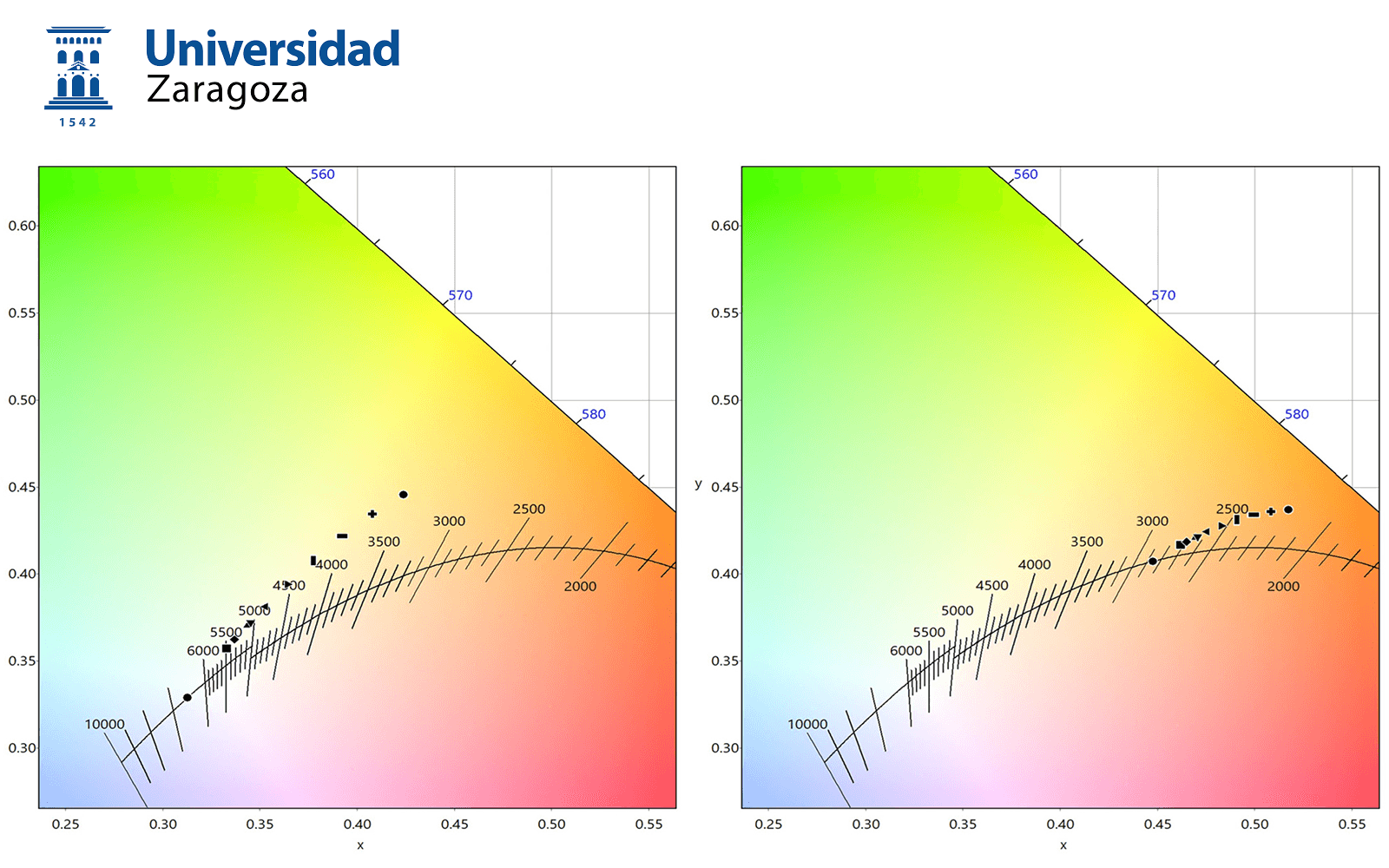
Chromatic diagram representing the location of the D65 and A standard illuminants by optical density and age, from 10- to 90-year-old observers. Left: D65 illuminant. Right: A illuminant.

As an example of this proposed method, calculations were performed with both the D65 and A standard illuminants, showing how the spectral power distribution is modified by the optical density of the crystalline lens, mainly at short wavelengths. Due to these selective wavelength absorptions of the aged lens, a significant variation in the level of daylight equivalent melanopic illuminance (EDI) is present in the retina. With levels of 200 lux at the corneal plane, these variations ranged from 204 EDI lux to 178 EDI lux for the D65 standard illuminant, and from 99 EDI lux to 101 EDI lux for the A standard illuminant for observers aged 10 and 90, respectively.

In this work, the authors aimed to simplify the greatest possible level of calculation of melanopic light, while describing simple protocols that are easy to translate into practice. Their results will allow researchers to carry out optimized lighting designs from both the photometric and circadian perspectives considering the optical density of an aging lens.

Appl. Sci. 2023, 13(4), 2569; https://doi.org/10.3390/app13042569

Received: 19 January 2023 / Revised: 13 February 2023 / Accepted: 14 February 2023 / Published: 16 February 2023

Read the full research article here: https://www.mdpi.com/2076-3417/13/4/2569

Hat dir der Artikel gefallen?

Share this article

You could also like this

Optics

Materials as a Key Enabler for Next-Generation LED Lighting

Executive Summary: As LED technology approaches its theoretical efficiency limits, materials are becoming a primary driver of future lighting innovation. Advanced silicone materials improve optical stability, thermal management and long-term reliability compared with conventional thermoplastics.…

Optics

Gaggione Introduces HADAR: A Modular Optics Platform for Architectural Lighting

French optics specialist Gaggione has launched HADAR, a new modular family of architectural optics designed to simplify beam control while increasing flexibility for luminaire manufacturers and lighting designers. Available in three sizes—HADAR35, HADAR50, and HADAR70—the platform combines…

Optics

Dow’s New Study Bridges the Knowledge Gap on Blue Light Photothermal Aging of Thermoplastic Lens Clusters in LED lighting

Dow announced the results of a new study that evaluated the aging performance of commercially available lens clusters in LED lighting. The study examined blue light photothermal aging of both silicone and thermoplastic optics made of polycarbonate (PC), polymethyl methacrylate (PMMA) and…

Optics

AAC Technologies and Eulitha Announce Use of Eulitha’s Optical Lithography for Volume AR Waveguide Production

AAC Technologies, a global leader in advanced consumer electronics components and modules, and Eulitha AG, a pioneer in high-throughput optical lithography, today announced at the SPIE AR/VR Conference that AAC will begin utilizing Eulitha’s lithography technology for the volume production of…

Edison optoLTF TechnologyLoreos

The latest Press Releases

Explore All

Stay current with our monthly Update from the lighting industry

LEDprofessional Newsletter

You will receive a confirmation email. Unsubscribe anytime.