Regulations
Celsia Introduces Next Generation Heat Sink Technology
Already credited with making vapor chambers (a once exotic heat sink technology) thin, light and affordable, Celsia Technologies (“Celsia”) today introduces its second generation NanoSpreader.
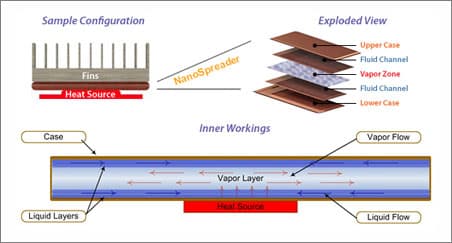
Thermal transfer properties from the heat source to the vapor have been improved by 66 percent over the first generation, using a re-engineered internal structure that leverages the company’s patented combination of copper, liquid and vapor. These changes, developed through extensive collaboration with industry-leading computing and graphics manufacturers, give the new NanoSpreader the ability to trump heat pipes as the king of costeffective cooling.
“While maintaining reliability standards and manufacturing costs, our engineers have designed this next generation product to offer up to 30 percent better thermal performance than solutions using traditional heat pipes, and their design flexibility allows them to be used in some unexpected ways,” said Joe Formichelli, Celsia’s CEO. “For instance, a single NanoSpreader can be made up to 70mm wide and attach directly to the heat source, eliminating the need for additional components while completely covering even a very large hot spot.”
Nanospreaders are patented copper encased two-phase vapor chambers into which pure water is vacuum sealed. The liquid is absorbed by a copper wick and passed as vapor through a microperforated copper sheet where it cools and returns as liquid to the wick. The latest generation technology is ideally suited for solving some of today’s biggest thermal challenges: cooling the latest microprocessors, reliably operating in harsh environments, and effectively dissipating heat in small spaces. For examples of specific industry solutions, please visit http://celsiatechnologies.com/industry_solutions.asp.
LED Lighting - Effectively Dissipating Heat in Small Spaces:
While LED lighting technology is quickly offering an energy efficient alternative to other lighting technologies, it requires cooling solutions that are effective in small areas. The efficiency of Celsia’s NanoSpreaders combined into a remarkably thin package (from 1.5mm) allows lighting designs with higher lumens/watt.
For more information on Celsia or the technical details behind NanoSpreaders please visit Celsiatechnologies.com. A downloadable fact sheet describes the technology, lists 21 standard sizes, and includes information on thermal resistance and reliability testing. For frequently asked questions, visit http://celsiatechnologies.com/engineering_faq.asp.
Pricing and Availability:
The second-generation devices are available now, starting at under $2.00. To obtain application specific pricing, submit the quote request form found at http://celsiatech.com/quote.asp.
About Celsia Technologies:
Celsia Technologies is a full solution provider and licensor of thermal management products and technology for the PC, consumer electronics, lighting and display industries. The company is a leader in developing and commercializing next-generation cooling solutions built on patented micro thermofluidic technology. Celsia Technologies’ extensive intellectual property portfolio includes patents registered in Korea, the U.S., Japan and Taiwan, with patents pending in the EU, Russia, India and China.