Applications
Photometric Design for Solar Street Lighting: From Wattage to Road Performance
In many solar street lighting tenders, luminaires are still compared by wattage. A buyer may request a 40 W, 60 W or 100 W solar street light, assuming that a higher wattage automatically means better road lighting. Yet wattage only describes electrical input. It does not define road visibility, use
LED professional
10th, July 2026
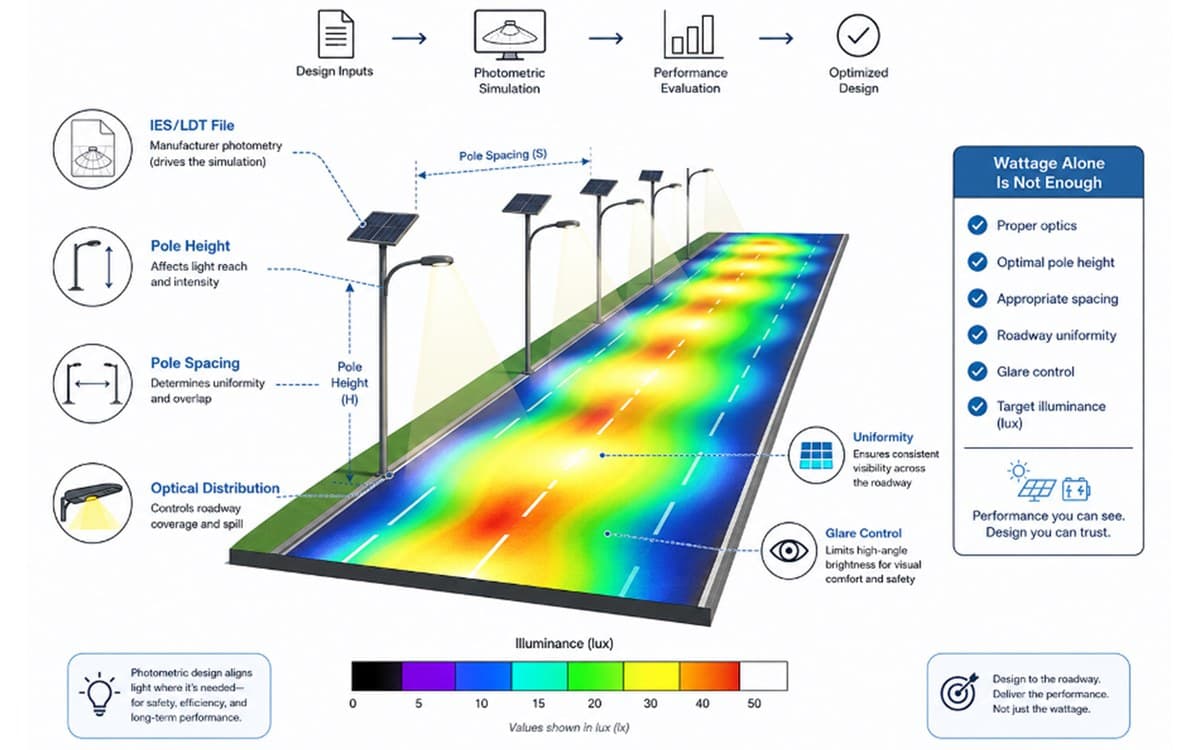
For EPC contractors, municipal buyers, consultants and lighting specifiers, this distinction is important. A solar street light is not simply a luminaire connected to a photovoltaic module and battery. It is an off-grid road lighting system that must satisfy two technical requirements at the same time: the lighting performance required on the road and the energy balance required to operate through real night-time conditions.
A proposal may look acceptable in a datasheet and still fail when tested against the actual road width, pole height, spacing, overhang, tilt angle, optical distribution, dimming schedule and autonomy requirement. For this reason, wattage should be treated as one input in the design process, not as proof of lighting performance.
Wattage describes the electrical power consumed by a luminaire under defined operating conditions. It is useful for estimating energy demand, battery size, photovoltaic capacity and controller rating. However, it does not answer the central question in a road lighting project: does the proposed system deliver the required visibility and uniformity on the road surface?
Two luminaires with the same wattage can produce very different results. One may use a higher-efficiency LED package, a better thermal structure, a more suitable optical lens or a more controlled light distribution. Another may consume the same power but concentrate too much light under the pole, spill light outside the carriageway or create glare at driver viewing angles.
Lumens provide more information than wattage because they describe total luminous flux. They show how much visible light the luminaire emits. But lumens still do not show where the light goes. A high-lumen luminaire may not perform well if much of the light is directed outside the useful road area or if the beam is not matched to the road width and pole arrangement.
For road lighting, the design logic should move through a hierarchy:
wattage -> lumen output -> optical distribution -> simulation result -> verified road performance
Wattage describes energy input. Lumens describe total output. Optical distribution describes how the light is directed. Simulation results show how the luminaire performs in the actual road layout.
This distinction is especially important for solar street lighting. Wasted light is not only a lighting problem; it is also an energy problem. If poor optics require higher wattage, closer pole spacing or longer full-power operation, the battery and PV system may also need to be larger. A more efficient photometric design can sometimes reduce energy demand while maintaining the required road lighting performance.
Optical distribution is one of the most important differences between LED street luminaires. Lenses, reflectors and LED arrays determine how luminous flux is distributed across the road. The same wattage and lumen output can produce different road results depending on the optical system.
A luminaire designed for a narrow road, pedestrian path or residential street may not be suitable for a wider municipal road, industrial access road, port perimeter or highway-adjacent service road. Single-side, opposite-side, staggered and central-median arrangements also produce different lighting patterns.
Poor optical distribution can create several project risks:
Hat dir der Artikel gefallen?